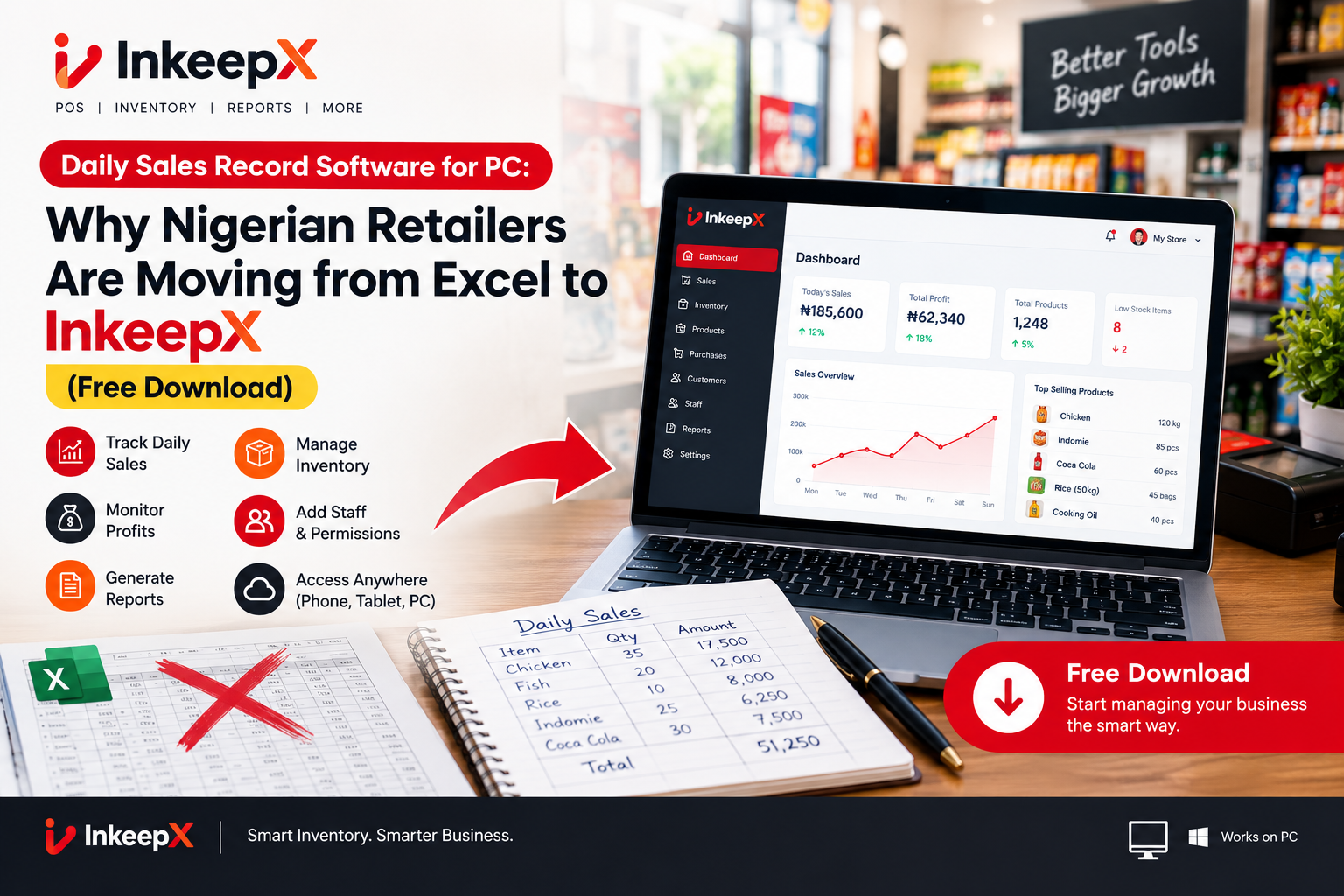
What Is the Best Sales Tracking Software in Nigeria?
The best sales tracking software in Nigeria should do more than record how much money your business made today.
A useful sales tracking system should help you answer questions like:
- How much did I sell today?
- What products sold the most?
- Which customers bought from me?
- Which staff members processed sales?
- How much did each location sell?
- How much did I spend?
- What products are running low?
- Which customers owe me?
- How is my business performing?
- Am I actually making a profit?
For a small business, these questions may be answered with a notebook or spreadsheet.
But as sales increase, products increase and more staff become involved, manual sales recording becomes harder to manage.
This is where sales tracking software becomes useful.
One option Nigerian businesses can consider is InkeepX, which combines sales tracking with inventory, customer management, expenses, staff controls, reporting and multi-location management.
Why Is Sales Tracking Important for a Business?
Every sale contains useful information.
Suppose your shop makes:
₦250,000 in sales today.
That number alone doesn't tell you much.
You also want to know:
What did customers buy?
Which products generated the most sales?
Who made the sales?
How much stock was used?
Were there credit sales?
What expenses did the business have?
How does today's performance compare with previous days?
This is why sales tracking should not be treated simply as a way to record cash.
It should become part of your overall business management system.
1. Record Every Sale Automatically
One of the main advantages of using sales recording software is reducing manual work.
When a customer purchases a product through the POS, the transaction is recorded in the system.
Instead of writing:
Product – Quantity – Price – Total
in a notebook for every customer, the POS can record the transaction electronically.
With InkeepX, sales transactions are connected to the business's product and inventory records.
That means a sale isn't just a financial record.
It also tells the system that stock has moved.
2. Track Your Daily Sales
One of the first things most business owners want to know each morning is:
How much did we sell yesterday?
A sales tracking system makes this information easier to access.
You can monitor sales by:
- Day
- Week
- Month
- Product
- Customer
- Staff
- Store/location
Instead of waiting until the end of the month to calculate your sales manually, your business information is available as transactions happen.
3. Know Which Products Are Selling
Total sales are useful, but product-level information can be even more useful.
Imagine your shop sells 500 different products.
You may discover that only 50 products generate a large percentage of your sales.
A sales tracking system can help you identify your best-selling products.
For example:
Top-selling products
- Product A
- Product B
- Product C
- Product D
This information can influence purchasing and inventory decisions.
If something sells quickly, you don't want to discover that you're out of stock only after customers start asking for it.
4. Connect Sales Tracking With Inventory
This is where sales tracking becomes much more powerful.
Imagine you sell:
20 cartons of drinks.
A simple sales tracker records:
₦300,000 sales.
But an integrated POS and inventory system can also reflect the reduction in stock.
That means your sales and inventory records remain connected.
The workflow becomes:
Stock Received
↓
Available Inventory
↓
Sale
↓
Inventory Reduction
↓
Sales Report
This gives the business a clearer picture of what is happening.
5. Track Customers and Their Purchases
Knowing your total sales is useful.
Knowing who is buying from you can be even more useful.
A business may have:
- Walk-in customers
- Regular customers
- Wholesale customers
- Restaurants
- Hotels
- Retailers
- Corporate customers
A customer management system allows you to associate transactions with customer records where appropriate.
Over time, this gives you a history of customer purchases.
You can understand which customers buy regularly and what they typically purchase.
6. Track Credit Sales and Customer Debt
Many Nigerian businesses sell products on credit.
This is especially common in wholesale and distribution.
For example:
A customer purchases goods worth:
₦300,000
but doesn't pay immediately.
If this transaction is recorded only in a notebook, tracking the outstanding balance can become difficult as more purchases are made.
With an integrated sales and customer management system, credit transactions can be associated with the customer's account.
You can then answer:
How much does this customer currently owe?
This is much safer than relying on memory.
7. Track Sales by Employee
If you have several employees processing sales, you may also want to know who handled each transaction.
For example:
Cashier A
Processed 45 transactions.
Cashier B
Processed 38 transactions.
This can help managers understand staff activity and investigate unusual transactions when necessary.
InkeepX supports staff accounts, roles and permissions, giving businesses greater control over who can access different parts of the system.
8. Track Sales Across Multiple Stores
Imagine your business has:
Store 1
Store 2
Store 3
Warehouse
Using separate notebooks or spreadsheets for every location can quickly become confusing.
A centralized system allows you to keep business information organized by location.
With InkeepX, businesses can manage multiple locations and compare business activity across stores.
This is particularly useful for owners who don't physically stay at every location.
9. Track Expenses Alongside Sales
Here's an important point:
High sales do not automatically mean high profit.
Your business may sell:
₦5 million
but have:
- ₦3.5 million cost of goods
- ₦400,000 salaries
- ₦200,000 logistics
- ₦150,000 rent/utilities
- Other expenses
Your actual business performance depends on more than your sales revenue.
That's why sales tracking becomes more useful when connected to expenses and other business records.
InkeepX can help businesses track sales alongside expenses and other operational information.
10. Understand Profitability
One of the most important questions for a business owner is:
"How much money am I actually making?"
Sales revenue is not the same thing as profit.
If you sell a product for:
₦10,000
and your cost is:
₦7,000
your gross margin isn't ₦10,000.
The cost of the product has to be considered.
A good business management system should therefore help you move beyond simply tracking revenue and towards understanding profitability.
11. Monitor Sales When You're Away From the Business
What happens when you leave your shop?
If you have to call your staff and ask:
"How much did we sell today?"
every evening, you may not have enough visibility into the business.
Cloud-based sales tracking can allow business owners to monitor important business information remotely.
This is especially useful if you:
- Own multiple stores
- Travel frequently
- Live in another city
- Manage another business
- Have employees running your shop
With InkeepX, business owners can monitor sales and inventory information remotely through the platform.
12. Don't Lose Sales When the Internet Goes Down
Internet connectivity can be a challenge for Nigerian businesses.
A POS system that completely stops working whenever the internet goes down can become a serious operational problem.
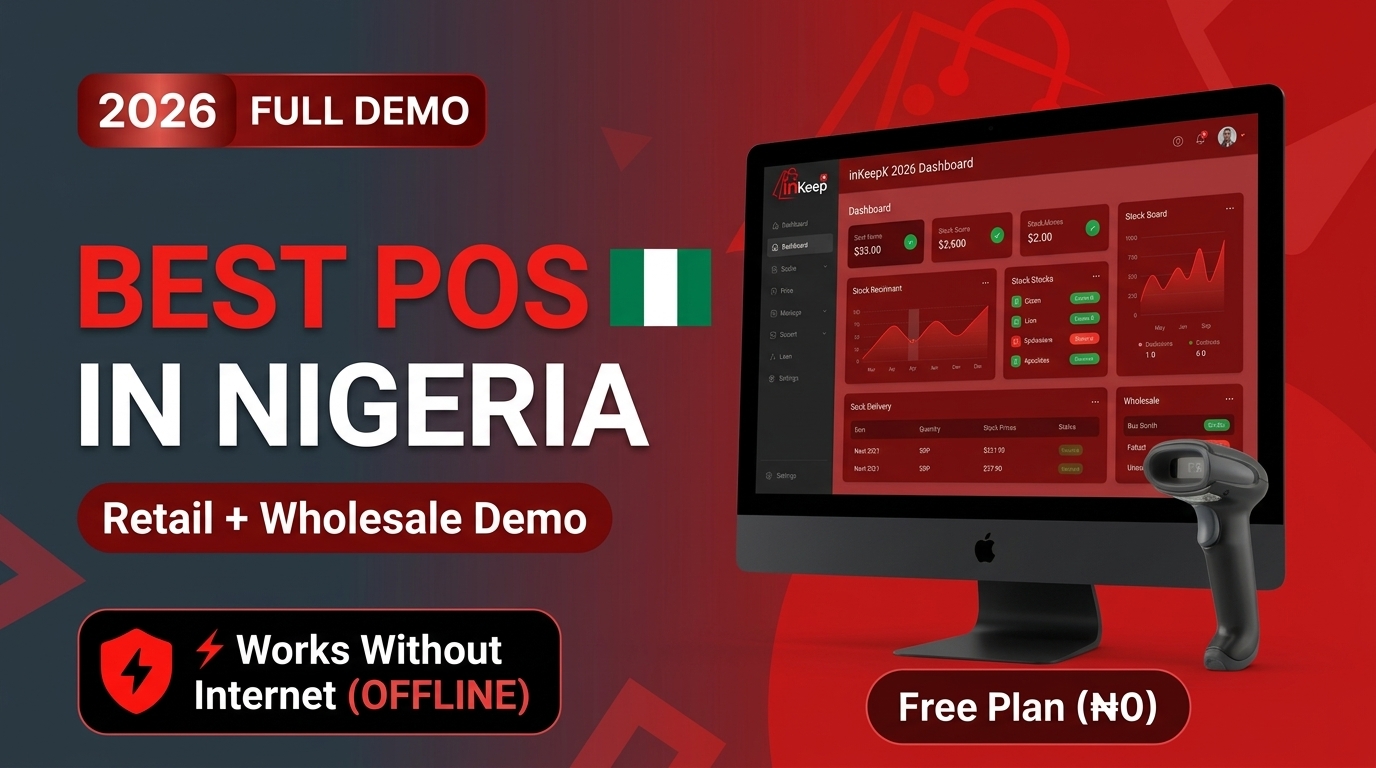
InkeepX provides an offline-hybrid desktop POS approach that allows supported sales operations to continue during connectivity interruptions and synchronize data when connectivity is restored.
For businesses processing sales throughout the day, this can be an important feature to consider when choosing sales management software in Nigeria.
13. Use Reports Instead of Guessing
Imagine asking yourself:
"I think sales were better this month."
Instead of guessing, your sales reports should give you the numbers.
You can look at:
- Total sales
- Sales by product
- Sales by location
- Sales by staff
- Customer transactions
- Purchases
- Expenses
- Inventory
- Profit-related metrics
The purpose of reporting isn't simply to produce charts.
It's to help you make better business decisions based on your actual records.
14. Use InkeepX AI to Ask Questions About Your Sales
This is where sales tracking becomes even more interesting.
InkeepX includes InkeepX AI, which allows business owners to interact with their business data conversationally.
Instead of manually opening several reports, you can ask questions such as:
"What were my best-selling products this month?"
"Which store had the highest sales?"
"Which products are selling slowly?"
"What products are running low?"
"How are my sales performing?"
The idea is simple:
Your business generates data. InkeepX helps you understand it.
What Should You Look for in Sales Tracking Software?
Before choosing a business sales tracker, don't look only at the price.
Consider whether the system can handle your entire workflow.
Sales recording
Can it quickly record transactions?
Inventory
Does every sale affect stock?
Customers
Can you maintain customer records?
Credit
Can you track outstanding customer balances?
Expenses
Can you record business expenses?
Staff
Can you control employee access and activity?
Multiple locations
Can you manage several stores?
Reports
Can you see meaningful sales information?
Remote access
Can you monitor the business when you're away?
Offline capability
Can your business continue operating during internet interruptions?
AI/business insights
Can the system help you understand your business data?
InkeepX as a Sales Tracking and Business Management System
InkeepX goes beyond simply recording sales.
It connects several parts of the business.
| What you need | InkeepX |
|---|---|
| Daily sales tracking | ✓ |
| POS sales recording | ✓ |
| Product tracking | ✓ |
| Inventory management | ✓ |
| Customer management | ✓ |
| Credit/debt tracking | ✓ |
| Expense tracking | ✓ |
| Staff permissions | ✓ |
| Multi-store management | ✓ |
| Stock transfers | ✓ |
| Business reports | ✓ |
| Remote monitoring | ✓ |
| Offline desktop POS | ✓ |
| AI business insights | ✓ |
This means your sales data doesn't have to exist separately from your inventory and customer records.
Everything can work together.
Who Needs Sales Tracking Software in Nigeria?
Sales tracking software can be useful for many types of businesses, including:
Retail Shops
Track daily transactions, products and inventory.
Supermarkets
Manage large product catalogues and multiple cashiers.
Pharmacies
Connect sales with inventory and product records.
Drinks Depots
Track wholesale and retail beverage sales.
Boutiques
Track products, variants, customers and sales.
Restaurants and Bars
Record orders, sales and business activity.
Electronics Shops
Track products, customers and transactions.
Spare Parts Dealers
Manage large product catalogues and inventory.
Wholesalers and Distributors
Track sales, customers, credit and stock across locations.
Manual Sales Tracking vs Sales Tracking Software
| Manual Tracking | Sales Tracking Software |
|---|---|
| Paper records | Digital transactions |
| Manual calculations | Automated calculations |
| Difficult to search | Easy to retrieve records |
| Separate stock records | Sales connected to inventory |
| Difficult multi-store tracking | Multi-location management |
| Customer debt can be difficult to follow | Customer balances can be tracked |
| Reports take time | Reports available from recorded data |
| Limited remote visibility | Cloud-based remote access |
| High dependence on memory | Historical transaction records |
Manual records aren't automatically bad.
They can work for very small operations.
The problem comes when the business grows beyond what manual processes can comfortably handle.
Final Thoughts
A sales tracker should answer more than:
"How much money did we make today?"
It should help you understand:
What did we sell?
Who bought it?
Which products are moving?
Which staff handled the transactions?
How much stock remains?
Who owes the business?
What expenses did we have?
Which location is performing?
Are we actually making money?
That's why choosing sales tracking software in Nigeria should be about more than finding a digital cash register.
You need a system that connects your sales, inventory, customers, expenses, staff and reports.
InkeepX is designed to bring these business operations together in one platform, while giving owners the ability to monitor their business remotely and use InkeepX AI to get insights from their business data.
Track your sales. Understand your business. Make decisions with better information.
Frequently Asked Questions
What is sales tracking software?
Sales tracking software is a digital system that records and organizes business sales, products, customers and transactions. More advanced systems can also connect sales with inventory, expenses, staff, credit and business reports.
What is the best sales tracking software in Nigeria?
The right software depends on the business's size and requirements. Look for a system that combines sales recording with inventory, customers, expenses, reporting, staff management and remote access. InkeepX provides these functions in one business management platform.
Can I track daily sales with InkeepX?
Yes. InkeepX records sales transactions and provides reports that help businesses monitor sales activity.
Can sales tracking software track inventory?
Yes. When sales and inventory are integrated, recorded sales can update inventory records, giving the business a clearer picture of available stock.
Can I track customer debt with sales software?
Yes, if the software includes customer credit management. InkeepX allows businesses to maintain customer records and track outstanding credit balances.
Can I monitor sales from my phone?
Cloud-based systems can provide remote access to business information. InkeepX is designed to help business owners monitor sales and other business activities remotely.
Can sales tracking software work without internet?
Some systems provide offline capabilities. InkeepX supports an offline-hybrid desktop POS approach for supported operations, allowing sales to continue during connectivity interruptions and synchronize when connectivity returns.
Is sales tracking software useful for small businesses?
Yes. Small businesses can use sales tracking software to replace manual sales records and build better visibility as the business grows.
Sales tracking software helps businesses record daily transactions and understand sales by product, customer, employee and location. The best systems also connect sales with inventory, customer credit, expenses and reports. InkeepX combines sales tracking, POS, inventory, customer management, expenses, multi-store management and business insights in one platform.